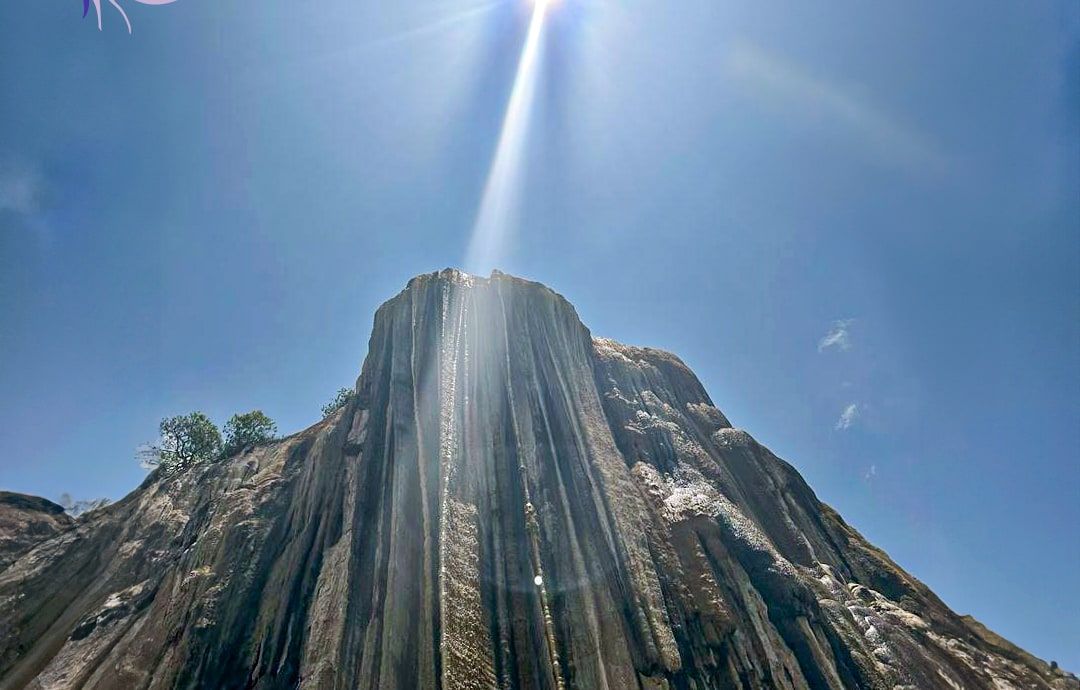
Hierve el Agua means “the water boils”, and the first thing to know is that nothing boils and nothing falls. What you see are two enormous rock formations built up over thousands of years by mineral springs running over the edge of a cliff, leaving behind something that looks exactly like a waterfall frozen mid-fall.
It is one of the most photographed places in Oaxaca and one of the most misunderstood. A little context makes the visit much better.
What you are looking at
The springs here carry a heavy load of dissolved minerals, mostly calcium carbonate. As the water trickles over the cliff and evaporates, it leaves the mineral behind, layer by layer. Over millennia those layers built the two formations people come to see: the smaller one, Cascada Chica, and the larger Cascada Grande.
At the top, the same springs feed shallow natural pools at the edge of the drop, with the mountains of the Sierra opening out below. The water is cool, not thermal, and it fizzes slightly where it comes out of the ground.
There is also archaeology here that most visitors walk past: the remains of a Zapotec irrigation system, canals cut to move this same water across terraces more than two thousand years ago.
Getting there from Oaxaca City
Hierve el Agua is east of the city, past the Tlacolula valley, near San Lorenzo Albarradas. The drive takes a couple of hours depending on traffic leaving the city and on the last stretch, which is narrow mountain road with curves and speed bumps.
The final kilometres are the slow part. This is one of the reasons the site is almost always visited as a full day rather than a quick stop.
When to go
Early. The site gets busy from late morning, and the light for photographs is better before the sun is overhead. Leaving the city early also means you reach the viewpoint before the tour groups that set out after breakfast.
The dry season, roughly November through April, gives you the clearest views over the valley. In the rainy months the landscape around it turns green, but afternoon clouds can close in on the view.
What to bring
Sun protection above everything. There is very little shade at the top and the altitude makes the sun stronger than it feels. Hat, sunscreen, and more water than you think.
Shoes with grip, because the paths down to the formations are uneven and the mineral surfaces can be slippery. If you plan to get into the pools, bring a swimsuit and a towel; facilities are basic.
Cash in small bills for local fees, food and crafts. Do not count on card payments or a reliable signal.
Access can change — check before you go
This matters. Hierve el Agua sits on communal land, and over the years access has been interrupted during disputes between communities, and at times restricted for conservation. Closures have happened with little warning.
Before committing a day to it, confirm that the site is open and whether the pools are accessible. We check conditions the morning of every tour and tell travelers honestly when something is closed, rather than driving two hours to find a gate.
What else is on that road
The drive out passes some of the best stops in the valley, which is why it is rarely done alone. El Árbol del Tule, the widest tree in the world, stands in a churchyard a short way out of the city. Teotitlán del Valle, the Zapotec weaving village, is a turn off the same highway.
Mitla, with its stone fret mosaics, is close to the turnoff for Hierve el Agua, and Santiago Matatlán — the self-declared world capital of mezcal — is right there too. A well-built day usually includes two or three of these rather than all of them.
FAQ
Can you swim at Hierve el Agua?
There are natural mineral pools at the top of the cliffs. Whether they are open depends on local conditions and conservation decisions at the time, so confirm before you plan your day around swimming.
How long do you need there?
Most people spend one to two hours walking the viewpoints and the path toward the formations. With the drive and other stops, it is a full-day outing from the city.
Is Hierve el Agua hot water?
No. The name refers to the bubbling of the springs, not the temperature. The water is cool.
Last reviewed: