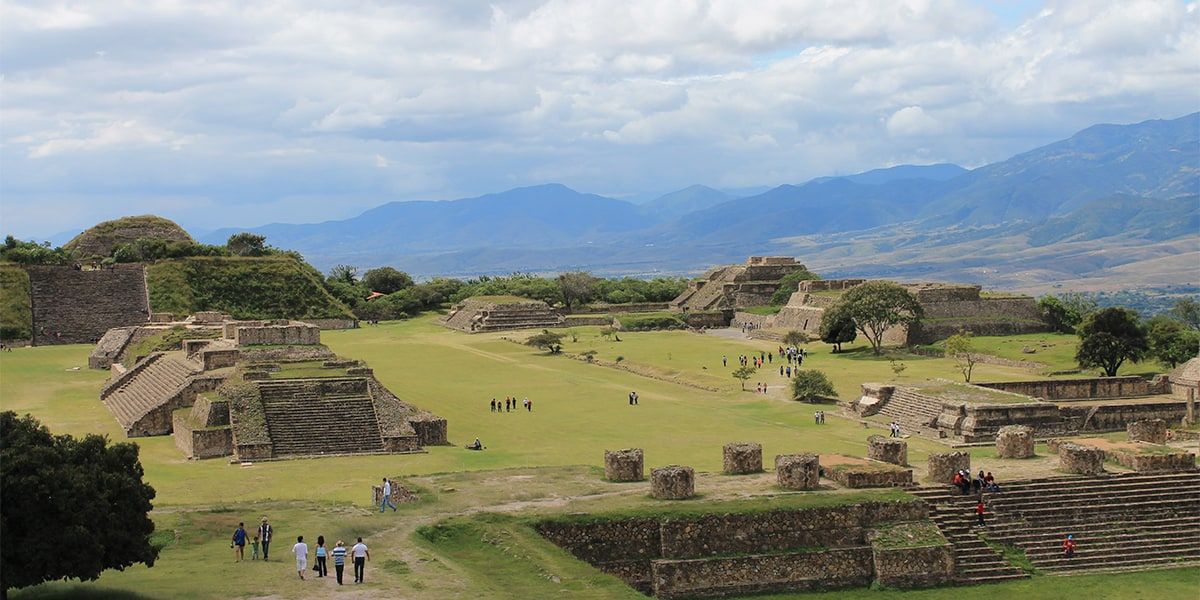
Monte Albán is the reason a lot of people come to Oaxaca, and the scale of it does not come across in photographs. The Zapotecs did not build on a hill: they levelled the top of one, roughly four hundred metres above the valley floor, and laid out a plaza on the platform they made.
It is a UNESCO World Heritage Site and it is close to the city, which makes it easy to visit and easy to underestimate.
What it was
Monte Albán was founded around 500 BC and became the capital of the Zapotec state, dominating the Valley of Oaxaca for more than a thousand years. At its height it held tens of thousands of people across the hillside terraces below the ceremonial center.
Its position is not an accident. From the plaza you can see where the three arms of the valley meet, which means its rulers could see everything that moved through them.
The city was largely abandoned as a political center centuries before the Spanish arrived, and the Mixtecs later reused parts of it, including its tombs.
What to look for
The Main Plaza is the heart of it: a vast rectangular space with platforms at the north and south ends and structures lining the sides. Walking its length is what gives you the sense of scale.
The Danzantes are the carvings people remember — stone slabs showing contorted human figures, long interpreted as dancers, now generally read as captives or war casualties. They are among the oldest carvings on the site.
Building J, in the middle of the plaza, is unmistakable: an arrowhead-shaped structure set at an angle to everything around it, pierced by a tunnel, and carved with glyphs often read as records of conquered places. Its orientation has long been linked to astronomical observation.
There is also a ball court, with the sloped sides typical of Mesoamerican courts, and the terraces and tombs spread out beyond the plaza.
Tomb 7 and where the treasure went
In 1932 the archaeologist Alfonso Caso opened Tomb 7 and found one of the richest burial caches ever excavated in the Americas: gold, turquoise, jade, rock crystal and carved bone, left by Mixtecs who reused the older Zapotec tomb.
The tomb is on the site, but the objects are not. They are displayed in the museum at Santo Domingo in the city, which is worth pairing with the ruins — seeing the plaza and then the things taken out of it makes both make more sense.
When to go and how long you need
Go early. There is almost no shade on the plaza, the altitude makes the sun stronger than it feels, and the site gets busier as the morning goes on. Hat, sunscreen and water are not optional.
Most visitors spend around two hours walking the plaza and the main structures, more if you take the terraces and the small site museum. With travel from the city, it works as a half-day, which is why it is usually combined with something else.
What to combine it with
The classic pairing is the artisan villages to the south: San Bartolo Coyotepec for barro negro, the black pottery; San Martín Tilcajete for alebrijes, the carved and painted wooden figures; and the textile and market towns of Santo Tomás Jalieza, San Antonino and Ocotlán.
Another good pairing is Atzompa, a smaller archaeological site related to Monte Albán and far quieter, in a village also known for its green-glazed pottery.
FAQ
How long does it take to visit Monte Albán?
Around two hours on the site for most visitors. With the drive from Oaxaca City it fits comfortably in a half day.
Is Monte Albán hard to walk?
The plaza itself is flat, but the ground is uneven and climbing the platforms involves steep, irregular steps. There is very little shade.
What is the best time of day to go?
Early morning: cooler, quieter and better light. Confirm current opening hours before you plan around them.
Last reviewed: